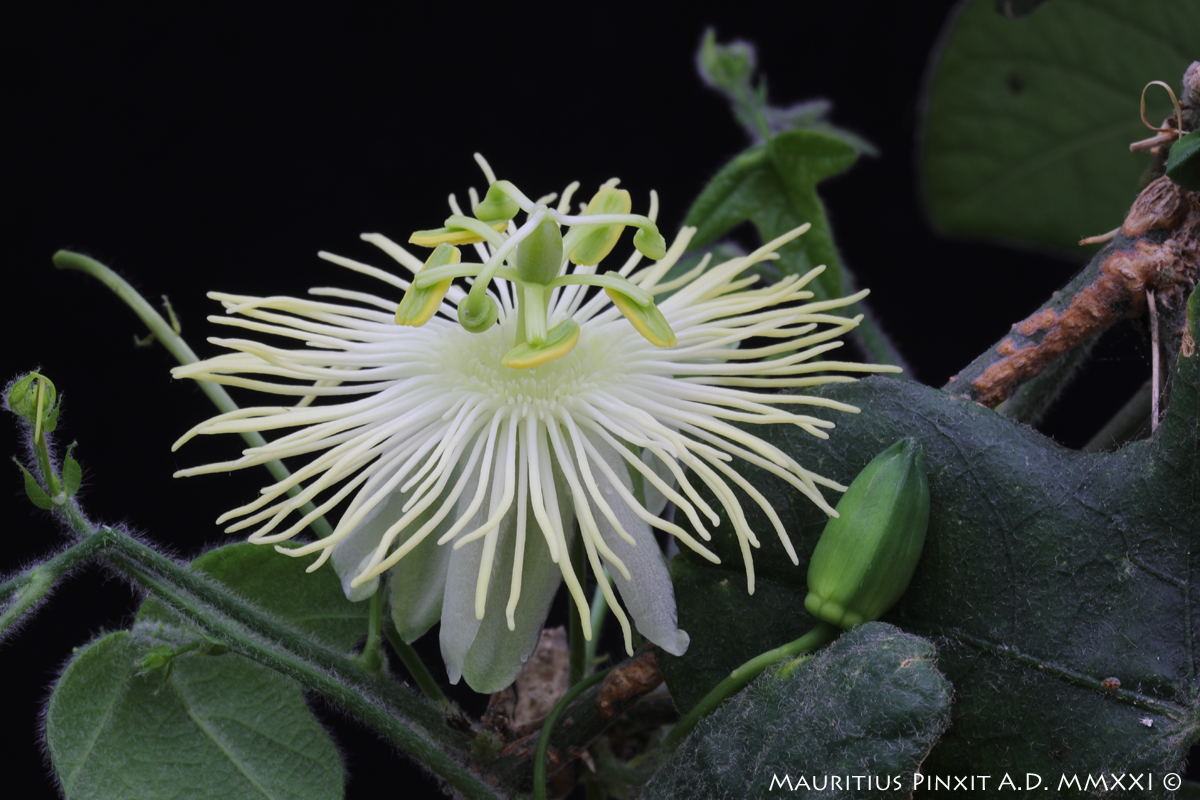
Passiflora asprantha
Kuethe (2024)


SUBGENUS: passiflora
SUPERSECTION: stipulata
SECTION: granadillastrum
GEOGRAPHICAL DISTRIBUTION OR ORIGIN:
Peru
CRITICAL MINIMUM TEMPERATURE: 8 °C
IDEAL MINIMUM TEMPERATURE: 12 °C
ETYMOLOGY: The name derives from the Byzantine Greek ασπρός, aspros, meaning “white”, and ἄνθος, anthos, meaning “flower”: therefore “with white flowers”.
DESCRIPTION:
When I began preparing the monograph of Passiflora hastifolia, which I have grown for many years, I realised that there was a rather significant problem. The flowers of my plant did not match those described by Killip in 1924 and later published in 1938 in the volume “The American Species of Passifloraceae”. The corona of Passiflora hastifolia is violet, whereas my flowers were completely white. The discrepancy was clear.
To clarify the situation, I sent several photographs to Yero Kuethe, a reliable and competent taxonomist. His reply was immediate: the plant was Passiflora asprantha, a newly recognised species from Peru that is often sold as Passiflora hastifolia, which is instead a Bolivian species. The mystery was solved. I updated the labels and informed the grower so that he could do the same.
Over the years there has been no shortage of Peruvian records that were initially attributed to Passiflora hastifolia. The recent revision carried out by Yero Kuethe has shown that this material belongs to a distinct species, described in 2024 as Passiflora asprantha (Kuethe, 2024). The two plants share some general features but differ in morphology and distribution, and for this reason the presence of Passiflora hastifolia in Peru must now be regarded as incorrect, leaving that species confined to western Bolivia.
According to Kuethe’s original description published in 2025, Passiflora asprantha is restricted to the transitional mountains of the San Martín department in northern Peru. The type specimen comes from the Juanjuí Tarapoto road, twenty to thirty kilometres north east of Juanjuí, at an altitude of about four hundred metres, on a roadside with secondary vegetation. The known collections place it along the Tarapoto Juanjuí axis and in the Tarapoto and Río Cumbasa area, between three hundred and fifty and eight hundred metres in altitude, on forest margins and in openings of primary or secondary woodland, often along roads and riverbanks, where it grows as a rather modest liana supported by shrubs and small trees.
A distinctive feature of the flower is the particular colouring of the corona. The filaments have a white base that gradually shifts to a pale yellow towards the tips. The intensity of this shade is not always constant, as it varies according to the season and the temperatures of the environment in which the plant grows.
The corolla consists of pale, slightly elongated sepals accompanied by shorter petals that complete a simple and orderly structure. The flowers are intensely fragrant, with a sweet scent that becomes noticeable during the warmest hours of the day. The corona has numerous, evenly arranged filaments that form a radial pattern, highlighting the transition from white to yellow towards the apices. Viewed closely, the corona reveals a fine and precise texture, while the central part of the flower remains clean and compact. It is a small flower in which the corona stands out thanks to its unusual colouring and the dense arrangement of its radiating filaments.
In cultivation Passiflora asprantha behaves with surprising consistency, particularly when compared with other, more demanding Peruvian species. It grows steadily even when conditions are not ideal and forms an orderly liana that adapts well to both light supports and more solid structures. It does not require high temperatures, preferring mild summers and protected winters. A bright position without the strongest midday sun is sufficient to keep it active throughout the growing season. The substrate poses no particular problems, provided it remains light, well drained and rich in organic matter.
Flowering is generous and extends through much of the warmer season. The flowers often appear in succession, keeping the plant attractive for long periods. The scent, sweet and immediate, recalls gardenia or jasmine and is especially perceptible in the morning.
Although formally described only recently under its new name, Passiflora asprantha has long been present in collections and proves to be a reliable and enjoyable species to grow. Its sober appearance, orderly flowers, pleasant fragrance and relatively simple cultivation make it an appealing choice for anyone wishing to explore less common passiflora species.