This species, discovered by the Dutch collector Cor Laurens and formally described by John Vanderplank in the Curtis’s Botanical Magazine in 2006 (volume 23, pages 237 to 242), takes its name from a small watercourse in French Guiana, the Crique Gabriel.
During one of my journeys in that region, together with a few companions I travelled along that very stretch of river in a motorised pirogue, its bow painted in bright colours and decorated with the traditional motifs of the local peoples. The atmosphere was particularly striking.
A dense shade surrounded us as extremely long lianas descended from above and sank into the water. Overhead, the large Morpho butterflies moved slowly, their wings a deep, intense blue. The silence of the forest on either side was broken by the calls of numerous birds that seemed to answer each other from one bank to the other. From time to time the Gabriel widened into a pool rich in aquatic plants, visited by web footed birds that swam through it in search of fish.
In this environment, through which we had passed rather quickly, the species eluded us, though we encountered it several times elsewhere. One specimen, enormous in size, grew near the Tikilili farmhouse where we were staying. It was reached by crossing a small bridge and, right beside it, stood a large Passiflora gabrielliana in splendid bloom.
Another grew on the bank of the Comptè river, near the small town of Cacao, and hung down towards the water. We collected numerous ripe fruits there, almost spherical, pale green in colour with six dark green vertical lines.
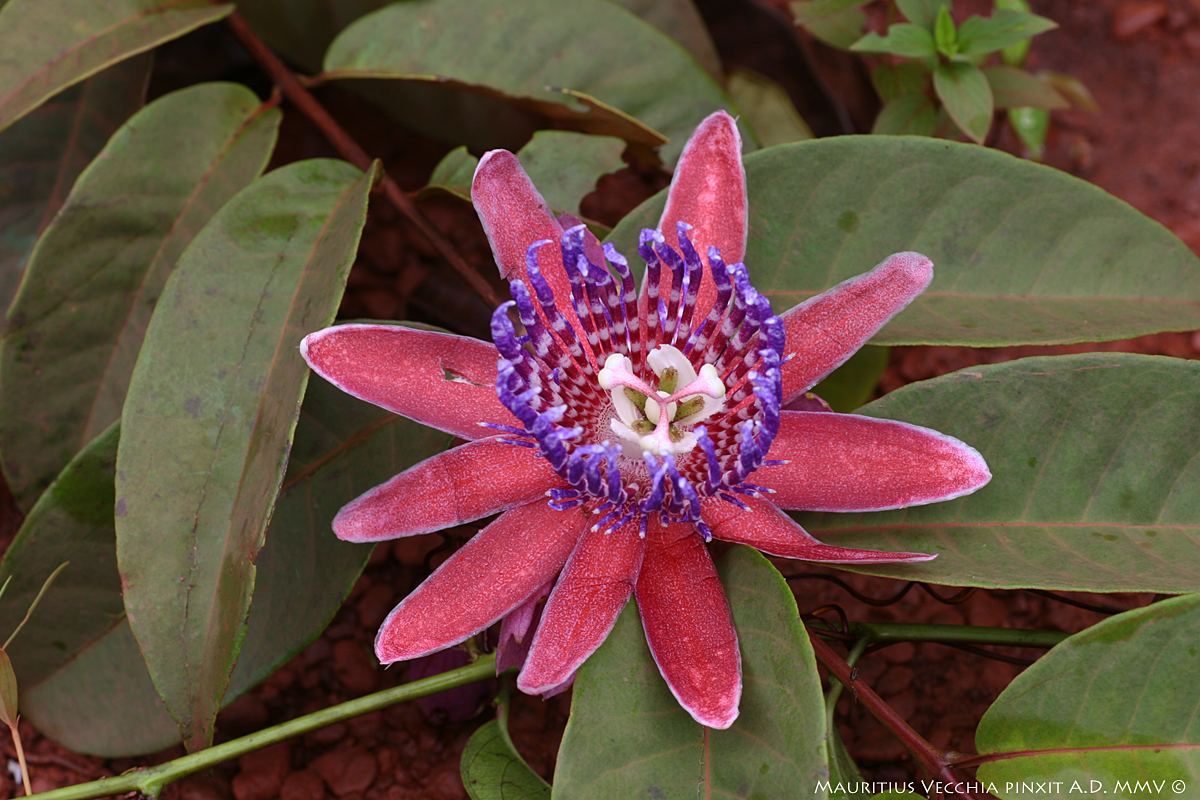
Passiflora gabrielliana is assigned to the supersection Laurifolia, series Laurifoliae, of the subgenus Passiflora. The flower displays colours playing on red, white and violet, and their alternation gives it a lively appearance.
The flower has sepals and petals of an intense red with purplish tones, crossed by delicate pale speckling that highlights their velvety surface.
The corona is composed of thick, sturdy filaments dominated by brilliant violet and characterised by white and purple bands that form a contrasting pattern. In the outer series the filaments are shorter and curve slightly towards the corolla, while in the next they become longer and project assertively in an almost vertical position. Towards the apex they take on a darker violet shade, while on the inner side they display a regular sequence of red purple bands alternating with white ones. The flower gives off a sweet and soft fragrance, not very strong but clearly perceptible during the warmest hours, with a fruity note that becomes evident when one approaches.
In Guyana rain is a constant presence. At night the sound of downpours is unceasing and only at dawn does it begin to subside, as the birds, silent until then, resume their calls. Even during the day there is no shortage of brief showers which, after each spell, leave a warm, light mist in the forest.
In such an environment passion flowers develop leathery, resilient leaves, glossy on the upper surface to help water run off. Those of Passiflora gabrielliana share the same characteristics. The blade is typical of the Laurifolia supersection and the upper surface is shiny. The elongated, lanceolate shape is perfectly suited to a constantly humid climate.
In cultivation it is not an easy species. I believe it is difficult to see it in flower and imagine that this may only occur in large, vigorous specimens kept in warm and humid conditions. A large tropical glasshouse, like those found in major botanical gardens, would be the ideal setting.
As it originates from French Guiana, it requires a highly porous substrate, similar to the red laterite in which rainwater hardly forms puddles because it is absorbed immediately.
Overall, Passiflora gabrielliana is a captivating and demanding species, tied to the humid landscapes of French Guiana and able to reveal its full potential only in warm, protected environments where it can express the strength and richness of its flower.