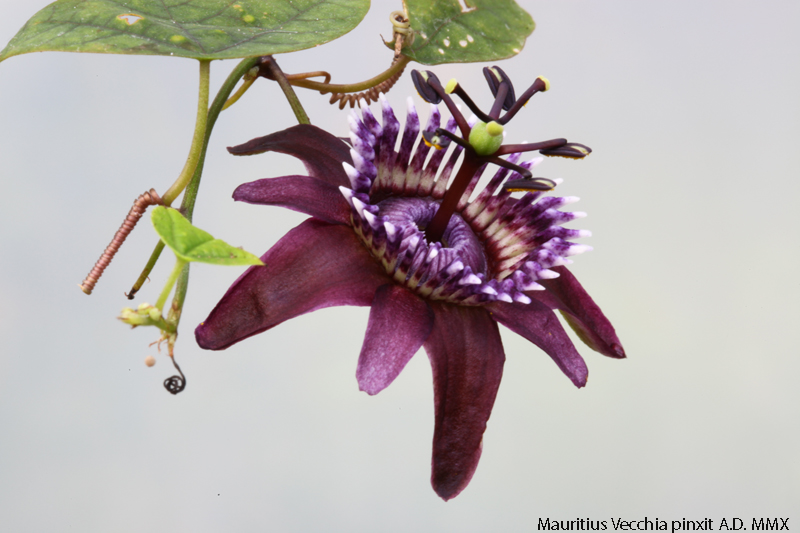
Passiflora glaucescens
Killip (1938)


SUBGENUS: decaloba
SUPERSECTION: decaloba
SECTION: decaloba
GEOGRAPHICAL DISTRIBUTION OR ORIGIN:
Brazil.
CRITICAL MINIMUM TEMPERATURE: 10 °C
IDEAL MINIMUM TEMPERATURE: 12 °C
ETYMOLOGY: From the Greek γλαυκός (glaucos) and the Latin glaucus, greenish, grey blue, light grey in colour, referring to the colour of the underside of the leaves.
DESCRIPTION:
Passiflora glaucescens is still a poorly documented species. The available descriptions are minimal, and even Killip, who first presented it, limited himself to a few notes based on a single herbarium specimen. The chosen name refers to the colour of the underside of the leaves, which shows a pale and matt shade reminiscent of glaucous tones.
Despite the scarcity of information, the plant is well known among enthusiasts. It appears in the catalogues of specialist nurseries and is grown in several collections, as its flowers attract interest.
Its name is sometimes considered a synonym of Passiflora porophylla and Passiflora organensis, although the authoritative sources I have consulted regard them as three distinct species, albeit closely related.
In Passiflora glaucescens the corolla consists of sepals and petals that are very similar to one another, both showing a deep purplish brown that fades into a soft green near the apex. The whole structure is compact and provides a uniform background against which the corona stands out as the most recognisable feature of the species. The filaments are arranged in two main series. The outer series bears robust filaments, white at the tip and marked at the base by a purplish band that quickly shifts towards violet. The transition of colour is clear and pleasant, and the alternation of light and dark tones gives the structure a balanced appearance.
The second series, made up of shorter filaments, is bent towards the androgynophore and forms a small cone that remains slightly open at the top to allow access to the pollen. Shades of purple, violet and brown dominate the flower, accompanied by the bright white that highlights the tips of the filaments.
Passiflora glaucescens belongs to the flora of Brazil, specifically the State of Rio de Janeiro, and grows at low altitudes up to five hundred metres above sea level. Its habitat is the caatinga, a vast biome of north eastern Brazil characterised by a hot climate and long dry periods. The vegetation consists of shrubs and small trees that lose their leaves during drought and frequently bear spiny structures. The landscape alternates brief rainy seasons with long arid months and hosts a remarkably varied flora, with many species adapted to demanding environmental conditions.
In cultivation Passiflora glaucescens performs very well and is a reliable species, easy to manage and generous in flowering. Its size remains moderate, which makes it suitable even for limited spaces. It does not require particular care, tolerates moderate watering, and endures short drops in temperature, qualities that make it suitable even for those with little experience of growing passion flowers.
Passiflora glaucescens is a species I value greatly. It is easy to grow and offers a notably abundant flowering, with truly unusual flowers. I am pleased to recommend it to anyone wishing to add something distinctive to their collection.