

ChatGPT ha detto:This species was long known under the name
To bring some order to this situation, John Vanderplank, curator of the National Collection of Passiflora in England, decided to retain the name Passiflora coccinea Aubl. for the Guianese species, and to assign the other, widespread on the South American mainland, the name Passiflora miniata. It should be remembered, however, that two years earlier Hilaire Annonay, in an attempt to clarify the same confusion, had already described the passionflower from French Guiana as Passiflora guyanensis.
This monograph concerns the former Passiflora coccinea that is not from Guiana, the one also grown in Europe.
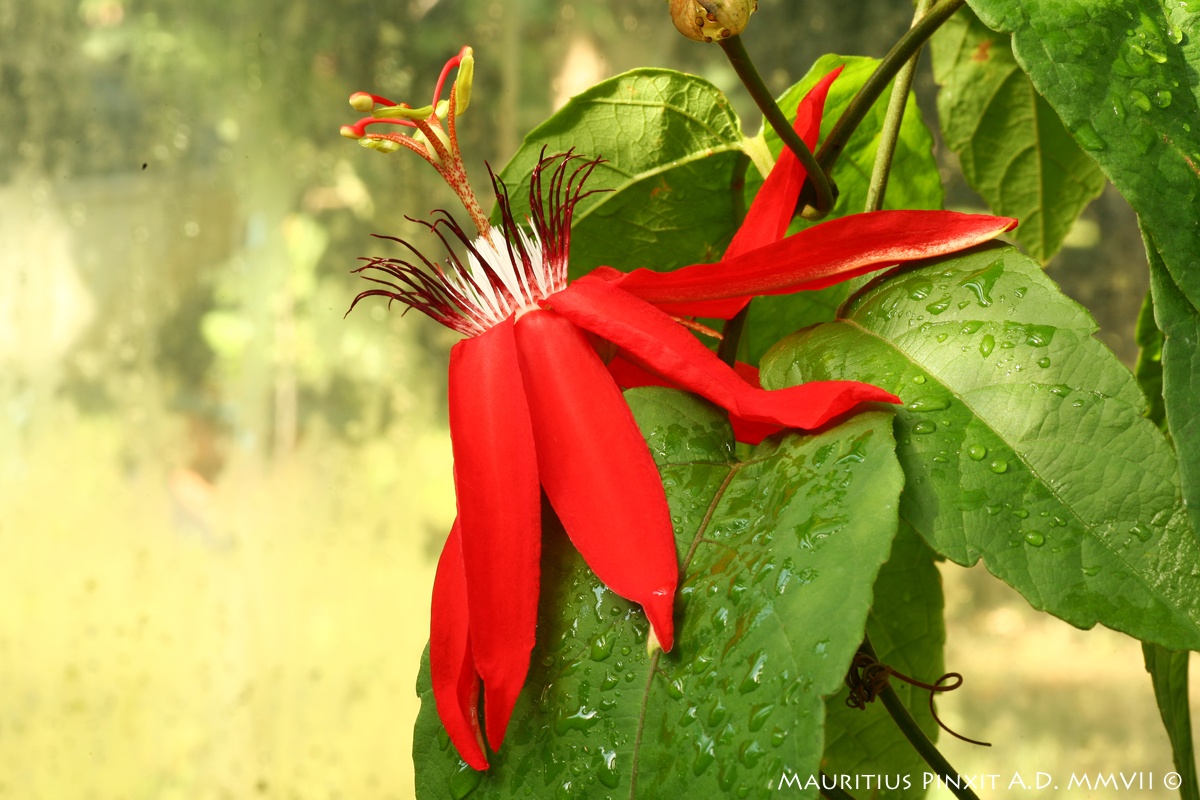
The red of Passiflora miniata is among the most vivid shades nature can offer. The large size of the flower amplifies its intensity and makes it even more striking.
This species occurs, with some variations, in the Amazonian flora of Brazil, Venezuela, Peru and Bolivia. It is a large tropical climber, vigorous and full of vitality. When in bloom, its bearing and size make it truly spectacular.
In cultivation, however, it should be given a spacious location and a suitably warm, bright environment, such as a heated greenhouse. A little patience is also needed, as it may take several years and perfectly favourable conditions before it flowers abundantly.
It is a demanding plant that responds well only when all factors are in balance: light, day length, temperature, air humidity and soil moisture. If any of these is lacking, flowering stops.
The leaves are covered with a fine rust-coloured tomentum. They are entire, lanceolate in shape, with margins that may be deeply toothed or serrated.
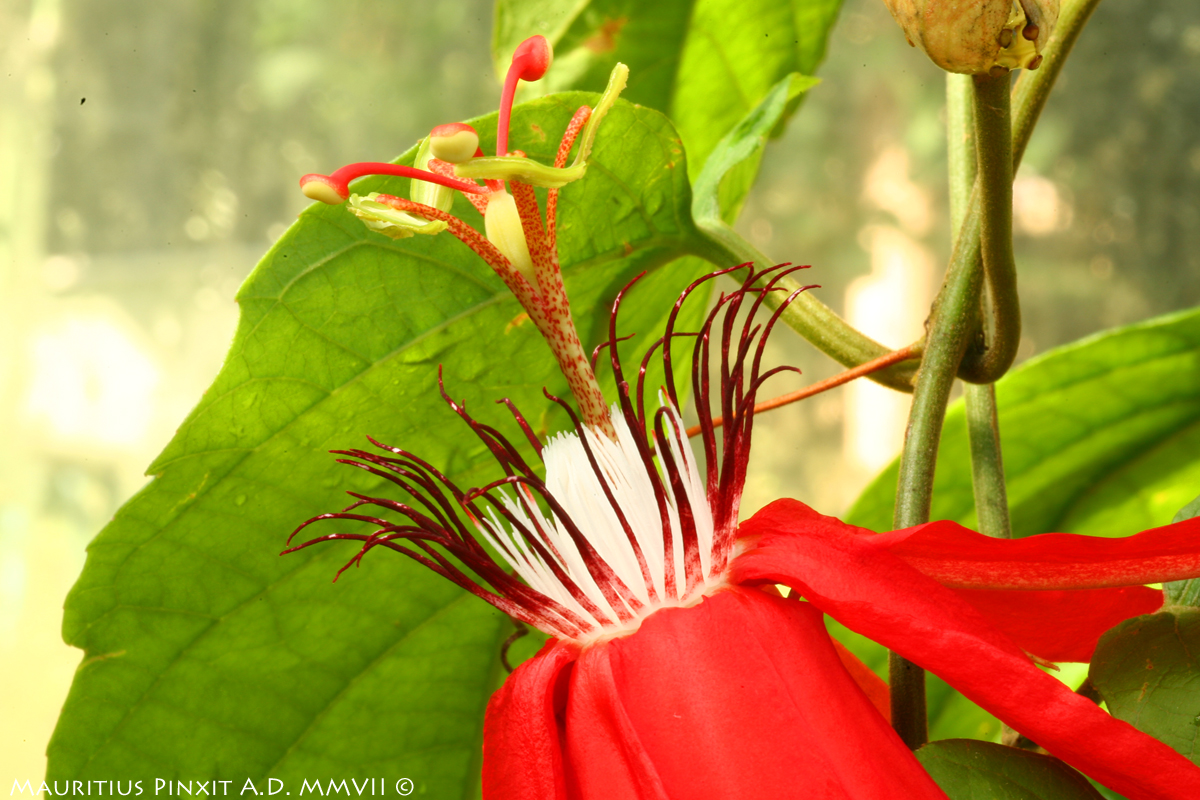
The buds are enclosed by three conspicuous reddish-orange bracts, rich in nectary glands. The flowers, ten to twelve centimetres in diameter, have sepals and petals of intense scarlet red, with margins that run parallel almost to the pointed apex.
After opening, they tend to bend backwards, though less quickly and less markedly than those of Passiflora vitifolia, to which the species bears a resemblance.
The corona forms a sharp contrast with the vivid red of the corolla, being composed of three series of upright filaments: the outermost is dark red, the others are white. The centre of the flower thus appears bright and pure. It differs therefore from the corona of Passiflora guyanensis, whose filaments are pinkish-white and pressed against the androgynophore.
The fruit, ovoid in shape, is also ornamental. It shows longitudinal stripes of dark green that turn yellow or orange as it ripens. Its flavour is excellent and it is considered among the finest produced by passionflowers.
The hardiness of Passiflora miniata is limited, and the plant requires high temperatures throughout the year. It should not be exposed to less than twelve degrees Celsius, while fifteen degrees represents the ideal threshold to keep it healthy.
It is advisable to grow it in a large pot that allows free development, using rich and well-drained soil. Fertilisation should be carried out regularly during the growing season.
It multiplies easily both from seed and from cuttings, and both methods give good results when carried out in a warm and humid environment.