Passiflora jiboiaensis
Milward de Azevedo (2008)


SUBGENUS: decaloba
SUPERSECTION: decaloba
SECTION: decaloba (presunta)
GEOGRAPHICAL DISTRIBUTION OR ORIGIN:
Brazil.
CRITICAL MINIMUM TEMPERATURE: 8 °C
IDEAL MINIMUM TEMPERATURE: 12 °C
ETYMOLOGY: This species lives in the Brazilian Serra da Jibóia (Bahia).
DESCRIPTION:
The Serra da Jiboia is a protected area in the State of Bahia, in north eastern Brazil. It is a ridge that reaches eight hundred metres in altitude and forms a humid island of the Mata Atlântica, surrounded by the arid zones of the caatinga. The climate is humid tropical, with mild temperatures and regular rainfall that keeps the humidity high for most of the year.
In this environment grows Passiflora jiboiaensis, a species endemic to the Serra da Jiboia, found at the edges of the forests where the soil remains moist and temperature changes are minimal. It was described in 2008 by the Brazilian botanist Michaele Alvim Milward de Azevedo of the Universidade Federal Rural do Rio de Janeiro, a specialist in the taxonomy of the genus Passiflora and author of the revision of the subgenus Decaloba in Brazil.
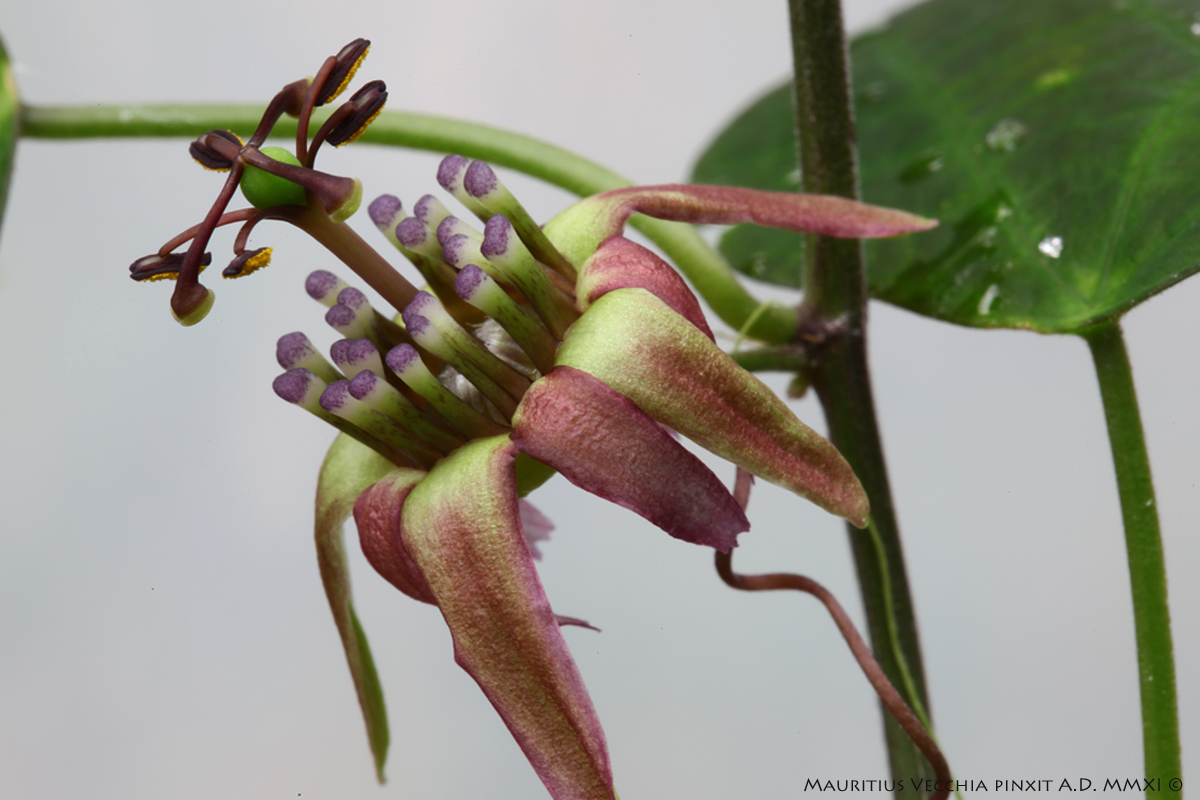
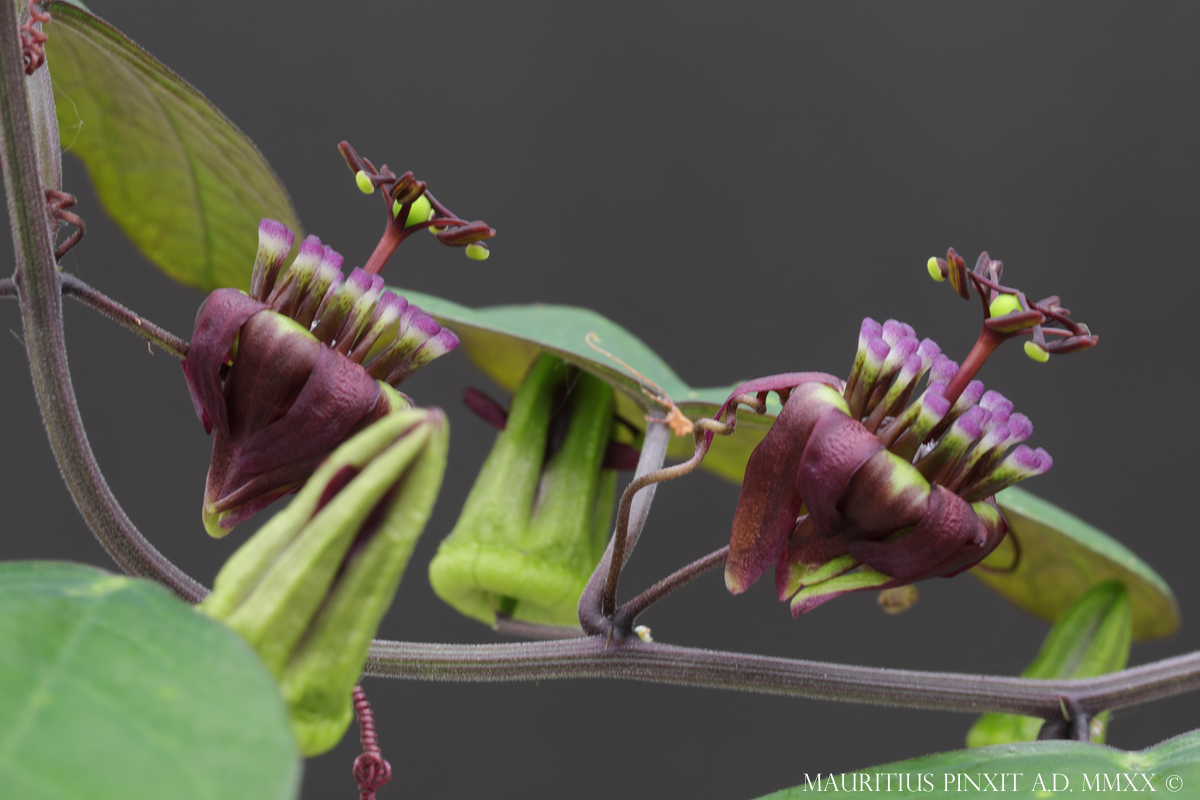
This species is unusual in the shape and colour of its flowers. The flower of Passiflora jiboiaensis is small and striking for the pronounced backward curvature of its sepals and petals. These are thick, waxy, and folded completely back until they almost touch the peduncle. The outer surface is pale green at the base and becomes purplish brown towards the apex, giving the whole structure a compact and harmonious appearance.
The corona is truly distinctive, even somewhat anomalous within the genus. It consists of a single series of vertical filaments, short and stout, arranged in a circle around the androgynophore. The base is greenish or whitish, while the tip, club shaped and rounded, is an intense purplish brown. The androgynophore, together with the styles, anthers and stigmas, shares the same dark tone, creating a uniform and unusual colour effect.
Taken together, the flower brings together earthy and violet shades in a restrained yet refined balance. The compact arrangement of the structures and the perfect symmetry give the impression of a small, carefully organised form, perhaps adapted to a specific pollinator. The buds, pointed and waxy, open slowly, revealing the internal complexity of the flower.
It is not a showy flower in the traditional sense, but its originality makes it one of the most distinctive among Brazilian passifloras.
Cultivating Passiflora jiboiaensis requires a degree of patience. It prefers steady warmth and high humidity, the typical conditions of the Serra da Jiboia from which it originates. It does not tolerate cold and stops growing if the temperature falls below twelve degrees Celsius.
It should be grown in a warm greenhouse or another protected environment, in a light soil rich in organic matter and kept constantly moist but well drained. It needs filtered light. Direct sun damages it, while deep shade slows its growth.
In cultivation it grows slowly and may take months to settle. Cuttings root with difficulty, although good results can be achieved with high temperatures and constant humidity. It is a delicate species suited to growers with experience in tropical passifloras, but it rewards the effort with flowers that are truly unique.
Passiflora jiboiaensis remains a little known rarity, yet it represents one of the most intriguing examples of diversity within the subgenus Decaloba.